
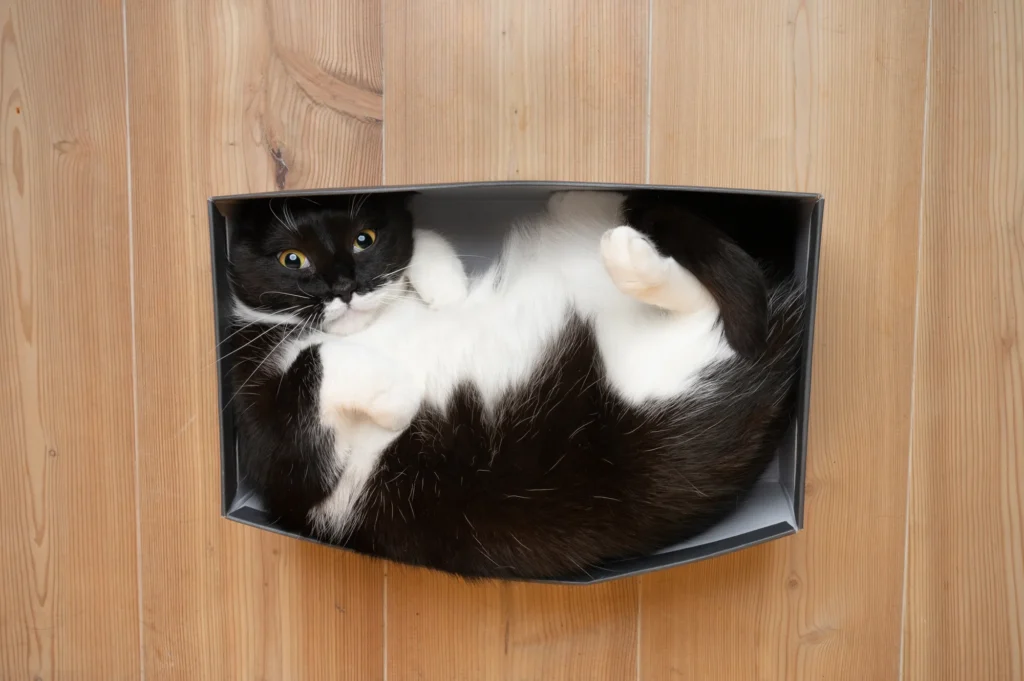
Have you ever found your cat squeezed into a box seemingly too small to contain it? This common observation sparked a global internet meme comparing felines to liquids and caught the scientific curiosity of physicist Marc-Antoine Fardin from the University of Paris Cité. His playful yet rigorous investigation into this phenomenon even earned him the Ig Nobel Prize in Physics in 2017, a prize for research that “first makes people laugh, and then think.”
The Rheological Question: Solid or Liquid?
To answer this, Fardin applied principles from rheology, the science of how materials flow. The key rheological definition is:
- A solid has a fixed shape and constant volume.
- A liquid has a constant volume but adapts its shape to its container.
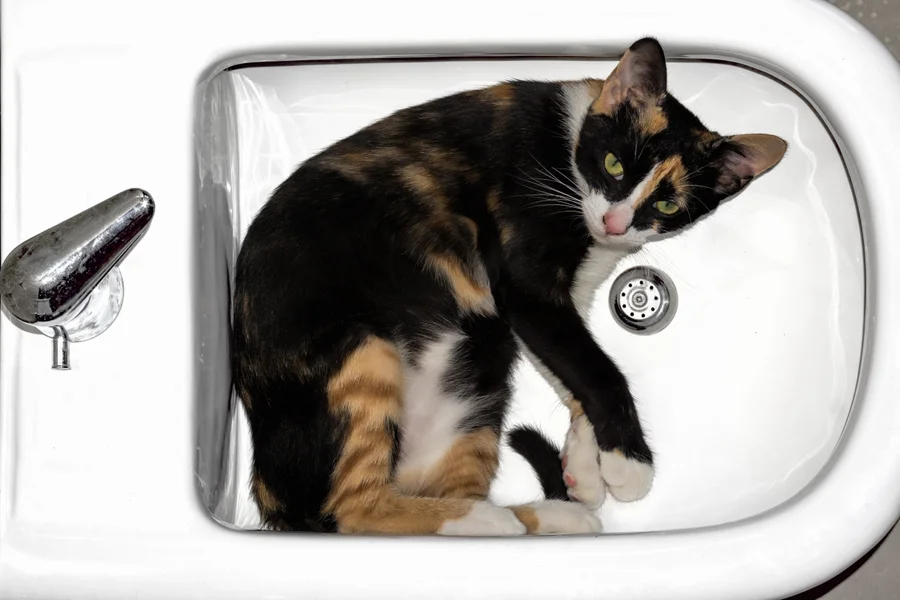
By this definition, a cat curling up in a bowl or a box is demonstrating liquid-like behavior. But the full answer is more nuanced.
The “Deborah Number”: It’s All About Time
Rheology teaches us that whether something appears solid or liquid depends on how long you observe it. This is captured by the Deborah Number (De).
- The Formula: De = (Relaxation Time τ) / (Observation Time T)
- Relaxation Time (τ) is how long a material takes to adapt to a container. Water does this instantly; honey takes longer.
- If De < 1, the material behaves like a liquid over your observation period.
- If De ≥ 1, it behaves like a solid.
For cats, Fardin estimated a relaxation time (τ) between 1 second and 1 minute for a young adult cat settling into a new space.
- Example: If a cat squeezes into a box in 5 seconds and you watch for a minute (T=60s), then De = 5/60 ≈ 0.083.
- Conclusion: With De clearly less than 1, the cat demonstrates liquid-like flow within that observation window.
More Liquid-Like Properties of Cats
Fardin’s analysis didn’t stop there. He noted other fluid-like traits:
- Yield Stress: Like ketchup in a bottle, a minimum force is required to make a cat “flow” out of its container (e.g., off your lap).
- Container Adaptation: They fill the volume of their container, be it a sink or a suitcase.
- High Surface Tension: This is evident when they maintain a cohesive, rounded shape while curled up in a tight space.
The Biological “Why”
Rheology explains how cats can be liquid-like, but biology explains why they are so good at it. A key reason is their highly flexible spine and the unique structure of their collarbones (clavicles). Unlike human clavicles, a cat’s clavicles are small and not rigidly attached, allowing them to compress their shoulders and squeeze through any opening their head can fit through.
Conclusion: A Purr-fect Model System
So, are cats liquid? Scientifically, they are a fascinating example of a “soft, active material.” While they are undoubtedly solid animals, from a rheological perspective, they can exhibit classic liquid behavior under the right conditions of time and space. As Fardin concluded, the cat has proven to be a rich model system for rheology—and a delightful reminder that science can find wonder in the most everyday mysteries.